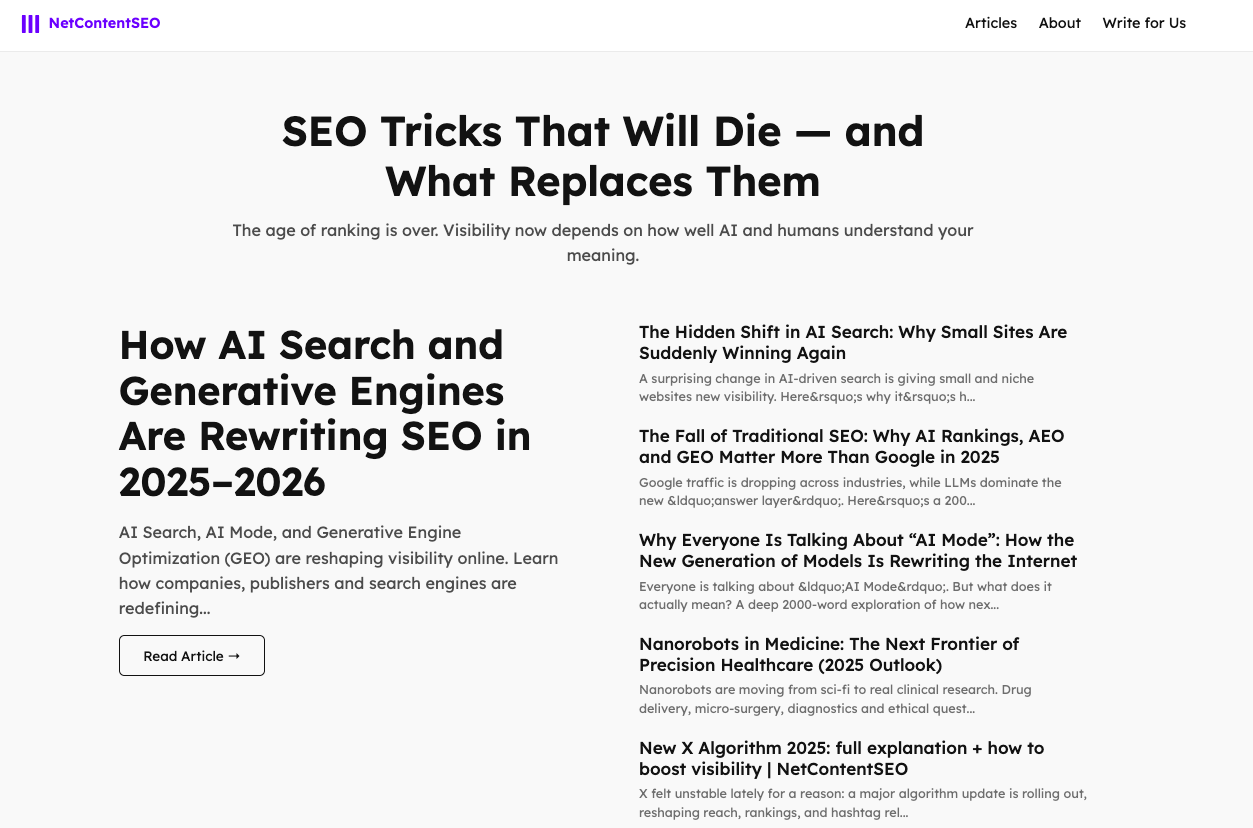
AI Search, GEO, and Strategic Visibility: The 2026 Shift According to NetContentSEO
The digital world is undergoing its deepest transformation since the creation of the web.
Where search engines once dictated visibility, AI systems are now emerging as the new gatekeepers of information, authority and reputation.
Generative engines—ChatGPT, Gemini, Grok, Claude, Perplexity—are not only answering questions but shaping user behavior, summarizing the web, filtering sources, and deciding which brands deserve attention.
In this GFPRx special analysis, built on the research published by NetContentSEO.net, we explore how AI search works, why traditional SEO is no longer enough, and what new strategies will matter most in 2026 and beyond.
1. From Search Engines to Answer Engines
For nearly two decades, companies fought for their position in Google’s SERPs. Being in the top three results meant traffic, leads and revenue.
But the rise of generative AI has disrupted this model completely.
Users no longer browse multiple links—they ask AI assistants for the answer and receive:
-
a fully synthesized summary,
-
curated knowledge,
-
citations only when deemed necessary.
This “answer-first” paradigm represents the collapse of the old search hierarchy.
NetContentSEO calls this the shift from:
SEO → GEO (Generative Engine Optimization)
a new discipline built entirely around AI engines, not human search engines.
2. AI Models Are the New Visibility Layer
AI systems are not simply querying the web; they are:
-
filtering low-quality content
-
identifying trusted authors
-
verifying information across multiple platforms
-
prioritizing structured and authoritative sources
-
building an internal map of entities, relationships and credibility
This means the true battle for visibility now occurs inside the model, not inside Google’s ranking pages.
Insights from NetContentSEO highlight several real-world signals confirming this:
Google AI Mode gets more transparent
The expanded source links and attribution in AI Mode mean Google is moving toward an AI-first user experience.
Meta licenses large news archives
Meta is strengthening its AI with verified journalistic sources—reducing reliance on generic or unverified web content.
Major brands produce content directly with AI
Companies like TUI are using AI to create full video campaigns, shifting user discovery away from search engines and into AI-driven inspiration funnels.
3. GEO: The Foundation of Future Digital Strategy
Traditional SEO optimized content for crawlers and keyword relevance.
GEO optimizes content so that AI engines understand it, trust it, and cite it.
SEO vs GEO (as defined by NetContentSEO)
| Traditional SEO | GEO |
|---|---|
| Optimizes for Google | Optimizes for AI models |
| Ranking pages | Being selected as a source |
| Keyword focus | Entity + context focus |
| Link-building | Authority-building across platforms |
| CTR metrics | Citation metrics |
| Human readers | Machine interpretation |
The rise of GEO means content must be crafted with:
-
structure
-
clarity
-
verified expertise
-
contextual relationships
-
cross-platform consistency
The shift is not optional. It is structural and irreversible.
4. Zero-Click Search and the Decline of SERP-Based Traffic
Google’s AI Overviews and AI Mode dramatically reduce the need for users to click through to websites.
Even when content is technically “ranked,” traffic collapses because:
-
the AI summary is complete
-
the user gets the answer instantly
-
the SERP becomes secondary
This phenomenon—known as zero-click search—is accelerating faster than predicted.
NetContentSEO warns that many brands will misinterpret declining traffic as a technical issue, when in reality:
They are being replaced by AI summaries.
The solution is not to chase rankings—
but to become part of the AI answer itself.
5. What AI Actually Looks For: Machine-Readable Authority
LLMs use a fundamentally different approach to evaluating information.
5.1 Entities > Keywords
AI models prioritize:
-
companies
-
technologies
-
people
-
places
-
definitions
-
timelines
They build semantic graphs, not keyword lists.
5.2 Cross-Platform Verification
If your brand appears consistently on:
-
LinkedIn
-
X
-
Reddit
-
YouTube
-
your websites
-
trusted news
-
structured databases
AI increases your trust score.
5.3 Depth and Explanation Quality
Models reward:
-
long-form articles
-
structured reasoning
-
clean formatting
-
FAQ blocks
-
citations to reputable sources
-
clarity over creativity
GEO is about being machine-understandable, not just human-readable.
6. NetContentSEO's New KPI Framework (Essential for 2026)
According to NetContentSEO, the next era of analytics will focus on:
6.1 AI Citation Frequency
How often AI models reference your domain.
6.2 Conversational Visibility Rate
Presence inside multi-turn AI dialogues.
6.3 AI Trust Score
The model’s internal assessment of your authority.
6.4 Semantic Drift Analysis
How your brand is interpreted vs how you want to be perceived.
6.5 Zero-Click Loss Index
Traffic displaced by AI summaries.
These KPIs are far more relevant than traditional rankings.
7. A Strategic Framework for AI-Ready Visibility (GFPRx Edition)
To compete in AI-driven environments, GFPRx recommends following this strategy roadmap—based on NetContentSEO’s research.
7.1 Build Long-Form, Expert-Level Content
1000+ words with:
-
clear sections
-
deep explanations
-
contextual examples
7.2 Implement Structured Data Everywhere
Use schema markup to help AI engines map your content.
7.3 Strengthen Brand Footprint
Visibility across numerous platforms boosts your AI trust score.
7.4 Use Entity-First Writing
Define people, companies, tools, categories—AI thrives on entities.
7.5 Maintain Consistency Across Touchpoints
Any contradiction lowers model trust.
7.6 Update Legacy Content for Machine Understanding
Rewrite outdated posts with structured clarity.
7.7 Track How AI Answers Questions in Your Niche
This reveals opportunities for strategic positioning.
8. The Strategic Battle of 2026: Competing Inside the Model
Search is transforming from a page ranking battle to a source selection battle.
Brands that adapt to this reality will earn:
-
persistent visibility
-
model-level credibility
-
organic citations
-
multi-platform recognition
-
long-term AI-driven traffic streams
Brands that ignore it will vanish from user consciousness—even if they “rank well.”
As NetContentSEO states:
“The real ranking is now the AI citation.”
9. Conclusion: Authority in the Age of Generative Engines
The world of 2026 is defined by generative engines, not search engines.
AI models filter the vast digital landscape and surface only what they trust.
To stay visible, businesses must build:
-
depth
-
clarity
-
structured knowledge
-
cross-platform authority
-
machine-readable identity
This ecosystem rewards expertise, transparency, and consistency.
And as the research from NetContentSEO.net demonstrates clearly:
SEO isn’t dying — it’s transforming into GEO, and the winners will be those who adapt early.